Everyone in procurement talks about comparing quotes "apples to apples". Ask the people who do it every day and the honest version is apples to rocks.
Here is how buyers actually compare supplier quotes in 2026 - the manual reality, the templates that half-work, and where AI actually helps - based on how procurement and construction people describe their own workflow.
The RFQ was never the hard part
Sending the request is easy. What breaks is everything after it. Quotes come back as PDFs, Excel files, plain emails and the occasional phone photo, and almost nothing lines up - each supplier answers in its own shape, leaves out whatever it feels like leaving out, and prices in whatever unit suits it.
In one lab buyer’s experience fewer than one quote in twenty arrives as anything but a PDF, so the default is still a person opening documents and reading them side by side.
“Ain’t nobody got time to open PDFs and transpose manually.”
The main issues in comparing quotes
What comes back does not line up in a few predictable ways. These are the main mismatches - not exotic, just the ordinary texture of comparing quotes.
Per-unit versus total. Is that the price of one, or of the whole quantity? The most basic ambiguity, and a constant trap.
Payment terms, scattered or missing. In a different place in every quote, in different terms - and sometimes left off entirely.
Unit-of-measure games. A day quoted as a month, a per-piece service quoted in cubic metres. Every mismatch is manual rework.
Package and step pricing. One lump for everything, or a price per production step - no per-item cost without rebuilding it by hand.
The clone-quote demand. Management wants every quote to look identical, even where the market has no standard way to price the thing.
Undefined scope. What did they actually price, and what did they quietly assume? The gap comes back later as a change order.
Hidden costs that surface late. "Shipping extra" with no figure, plus packaging, tooling and permits - charges that appear only after you choose.
Mixed currencies. Quoted in different currencies, so even the headline number is not comparable until every quote is normalised.
Clarification loops. Rounds of chasing suppliers to fill the gaps - and, for public buyers, routing each one through legal.
“The clarifications - tenderer, then legal, then back again, rinse and repeat - are sometimes soul-draining.”
How buyers actually compare
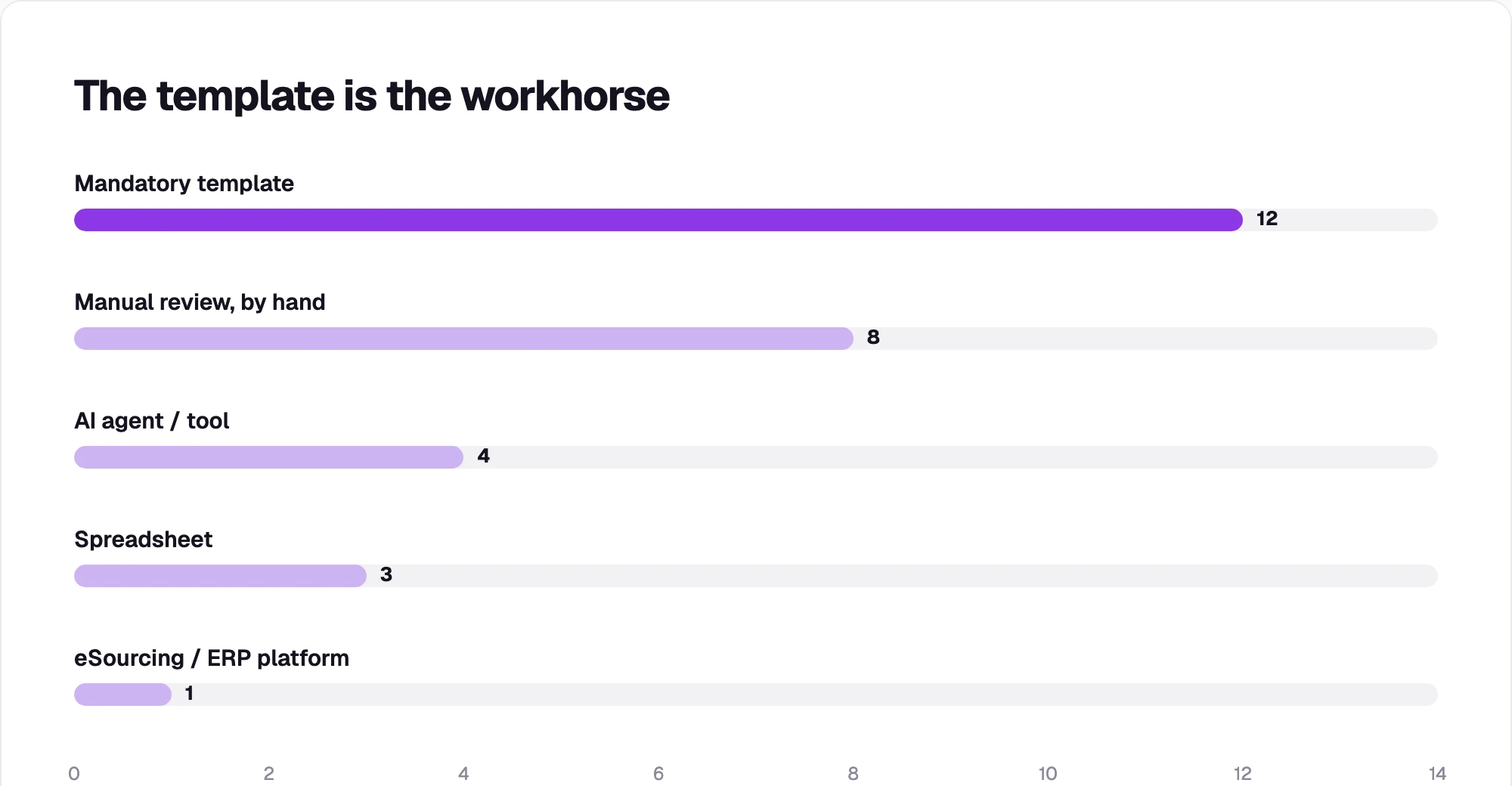
So what do people do about all this? Across five discussions - procurement teams, a small architecture practice and homeowners collecting contractor bids - roughly two dozen buyers described how they actually work. The mix is telling, because it is not a software catalogue.
The template is the workhorse - and it only half-works
The largest group by far enforce a mandatory response form and treat anything else as non-responsive. Homeowners, who have no such leverage, fall back on judgement instead - portfolio, references, licences and a phase-by-phase read of each bid. A smaller set lean on spreadsheets, one or two run an eSourcing or ERP platform, and a growing minority now put an AI agent in the loop.
But one method sits underneath all the others: manual review. For some it is still the entire job; for the automated setups it is the fallback for the roughly one quote in five their tools cannot parse. Nobody has escaped the PDF.
Where the buyer has leverage, the template works. A mandatory Excel form with your fields, your payment terms and Incoterms hard-coded, and a simple rule - no template, no consideration. But it has three well-known limits.
Suppliers still deviate. Even against a mandated form, a meaningful share come back half-filled or quietly reshaped.
Some buyers cannot enforce it. Public-sector buyers frequently cannot reject a bid on formatting alone; fairness rules force them to eyeball the messy submission or ask for a clean re-file.
It shrinks the field. The tighter the template, the fewer suppliers can or will respond - which works against competition and the discovery of new vendors.
“Quotes will only be accepted in the attached Excel document.”
The comparable-data gate
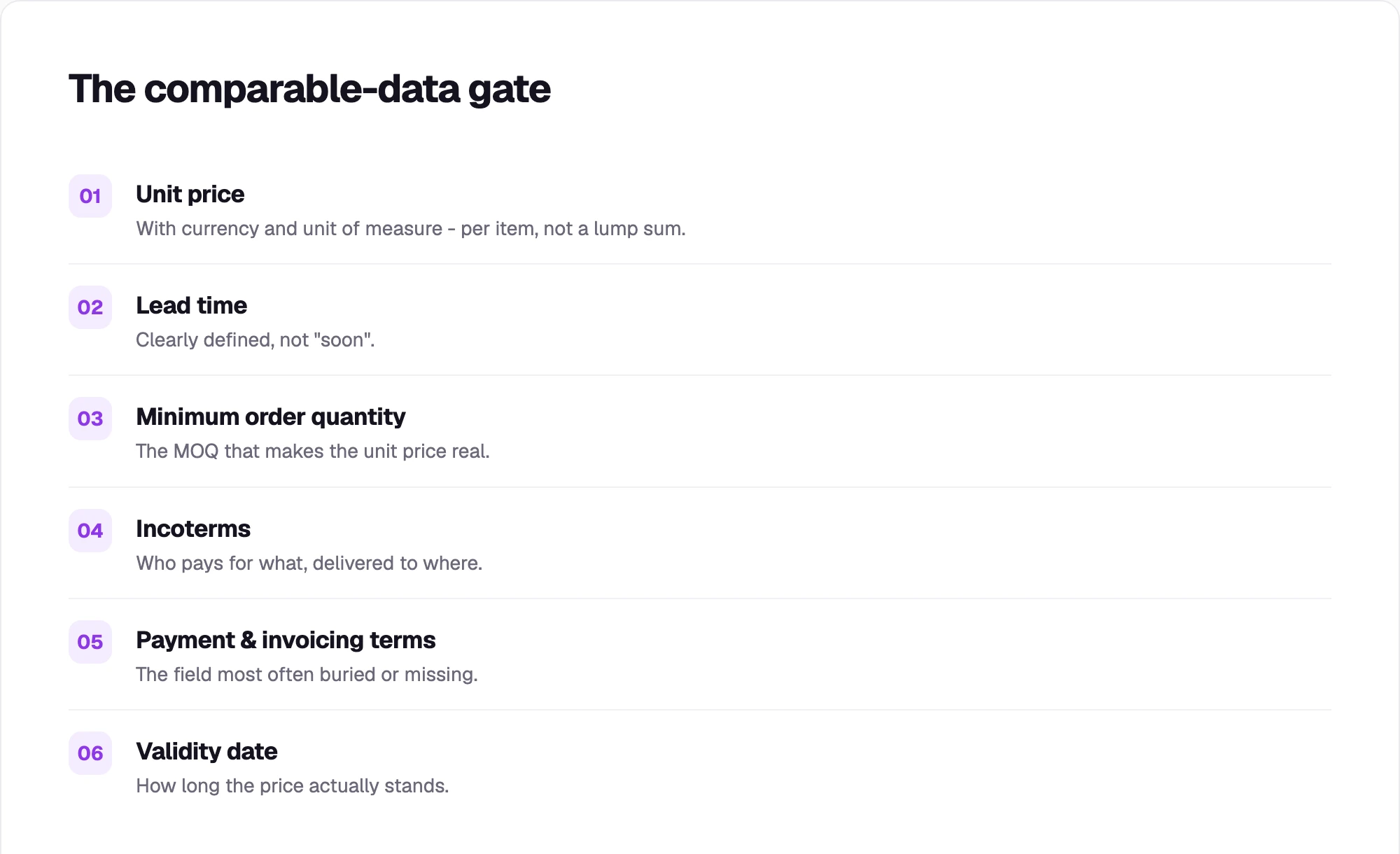
What actually holds across serious buyers is not really a template - it is a gate: a short list of fields every quote must carry before price even comes up. Enforce them and the comparison gets faster and the decision gets better, even without an expensive eSourcing suite.
The cheapest bid is rarely the cheapest project
It is a discipline, not a product: the buyers who enforce that gate do the work up front, defining what "comparable" means, and get it back many times over once the quotes land.
For anyone buying construction, price is the least reliable line in the quote. The low bid is often low because it quietly leaves something out - site prep, the permit, debris removal - and that gap resurfaces later as a change order, at a worse price and a worse moment.
The fix is not a cleverer spreadsheet - it is a disciplined scope. Break the job into phases and line each contractor’s price up against each phase. Anyone who answers "bathroom remodel = 50k" and nothing more filters themselves out, because the communication rarely improves once the work starts.
“A spreadsheet can’t tell you if the contractor forgot to charge for the permit or debris removal.”
Enter AI - help, not autopilot
The newest layer, and the reason half of these discussions exist, is AI. In 2026 it turns up in two forms. At the enterprise end, teams feed structured quotes into an AI comparison and let it flag the exceptions - one logistics team cut the first-pass review of a large third-party-logistics tender from a full week to roughly half that, with the machine surfacing which lanes a carrier could not cover across fifty-odd line items. At the individual end, buyers build their own agents to review quotes against a saved set of guidelines.
The same people are honest about the limits. Models still hallucinate, OCR on messy PDFs is unreliable, and the output always needs a human check - enough that one buyer’s verdict was that if you have to verify everything anyway, the time saved is smaller than it looks.
Two things separate the teams getting value from the ones getting noise: they define their evaluation criteria before the quotes arrive, and they keep a human firewall on top - the operations people who know, for instance, that a carrier has quietly renamed a destination to dodge a lane it cannot serve.
“The assumption is that I catch everything. Nope - the agent does.”
“It’s very important to have sound evaluation criteria saved before getting the quotes.”
What actually works
Put it together and a clear playbook emerges - and it has almost nothing to do with which tool you buy. Structure the ask before you send it, with your evaluation weights written down first. Treat completeness of scope and terms as more important than the headline number. Use AI to structure the chaos and surface blind spots, not to make the call. And keep the judgment - the sniff test, the negotiation, the "who do I trust in my home when I am not there" - firmly human.
The uncomfortable truth under all of it is that apples-to-apples is not something you find in the quotes. It is something you engineer before they arrive. The buyers who spend their effort up front - on the template, the gate and the criteria - spend far less of it later untangling PDFs and chasing down what a number really meant.
Inframat does the untangling part: quotes in whatever shape they arrived, levelled onto your own rows, with the gaps and the substitutions said out loud.
Read next
Market sentiment · 7 min read
Is the UAE construction sector cooked? A July 2026 read
Estimating · 9 min read
From drawings to the project price in construction
Procurement · 4 min read
What a concrete block actually costs in Dubai right now
Contracting · 6 min read
The general contractor’s cash gap
Labour · 6 min read
What construction workers in the UAE actually earn